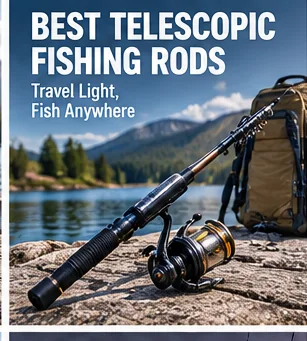
Products and configurations to compare
Medium telescopic spinning rod
Look for published lure and line ratings.
Best when: you want one compact freshwater or light-inshore rod
Watch for: section joints add weight and can loosen
Affiliate disclosure: We may earn a commission from qualifying purchases made through links on this page, at no extra cost to you.
Carbon telescopic rod compact
Keep joints clean and aligned.
Best when: packed weight and hiking matter
Watch for: thin sections require careful extension
Four-piece travel spinning rod
Multi-piece rods usually feel closer to conventional blanks.
Best when: you can tolerate a longer packed bundle
Watch for: slower setup
Collapsed length is the buying metric
A 28-inch collapse does not solve the same problem as a 17-inch one.
Guide alignment must be repeatable
Twisted sections can move guides off axis.
Do not force sections closed
Dirt and salt can cause sticking.
Travel rods need a case too
Compact does not mean indestructible.
Pair reel size to the rod
Avoid oversized reels on compact blanks.
Travel gear fails at connection points
Rod tubes, reel cases and travel kits are only as reliable as their latches, zippers, straps and internal padding. A hard shell protects against crushing but transfers shock to poorly secured rods; a soft case carries easily but depends more on careful handling. Assume checked baggage can be stacked, dropped and pulled by whichever handle is most convenient to the handler.
Separate fragile parts when possible. Reels and terminal tackle generally travel better in padded compartments than attached to rods. Photograph expensive gear and identifying marks before a trip. Airline sporting-equipment and oversize rules can change, so confirm the current policy before every flight instead of relying on a forum post from three years ago.
Pack for repair, not only fishing
A tiny tip-top repair kit, spare line, leader, one compact tool and a few high-confidence lures can save a trip when luggage or a broken guide creates trouble. Travel rewards simple, redundant essentials more than giant tackle selections.
Before checkout
- Gear matches bank, kayak, pier, surf, boat or travel use
- Rod and reel dimensions fit the case or holder
- Tray size matches the storage system
- Saltwater hardware can be rinsed and maintained
- Zippers, latches and straps work with wet hands
- Loaded weight is realistic for the walk
- Tools have a sheath or tether where appropriate
- Landing method matches the target species
- Kayak accessories keep rescue/paddle access clear
- Travel rules are checked again before departure
How to make the gear earn its space
The easiest way to overspend on fishing gear is to buy for imagined future trips instead of the next ten trips already on the calendar. Put the new item into the exact workflow before purchasing it: where it lives in the garage, how it reaches the vehicle, how it reaches the water, where it sits while you fish and how it gets rinsed or dried afterward. If any step is awkward, the product will gradually stop being used.
Compatibility is another hidden cost. Rod butt diameter, reel size, tray footprint, track-mount standard, case length and tankwell width are all measurable before checkout. Measure twice and compare published dimensions. Returns on long rod tubes, loaded tackle systems and kayak hardware are far more annoying than returning a small lure.
Saltwater and wet-use maintenance
Even corrosion-resistant gear benefits from freshwater rinsing and thorough drying after salt exposure. Open bags and cases when you get home, remove wet towels and soft plastics, dry pliers before storage and inspect hooks for rust. A sealed box full of damp terminal tackle can corrode an entire expensive inventory. Lubricate moving tools only with products appropriate to their materials and intended use.
For freshwater anglers, the same principle applies to mud and organic debris. Molded bases, removable trays and simple interiors are easier to maintain than highly segmented bags that cannot fully dry.
When to buy premium and when to buy simple
Spend more where failure loses expensive gear or ends the trip: rod transport, kayak attachment points, landing gear and primary pliers are good examples. Spend less on passive organization that can be replaced easily. A generic tray can hold weights perfectly well; a questionable rod holder can lose a $400 combo in seconds.
Premium also makes sense when the item is used every single trip. A comfortable backpack, smooth cart or good crate pays back through hundreds of repetitions. Specialty accessories used twice a year should clear a higher bar before taking permanent space.
First-trip test
Pay attention to the moments when fishing stops: searching for pliers, untangling a rod strap, turning around dangerously in a kayak, dragging a cart or opening four trays for one hook. Those delays tell you what to change. A good setup makes the boring transitions disappear so more time is spent casting.
After the trip, remove one item you did not use and move one frequently used item closer to hand. Repeating that for three trips creates a better loadout than copying somebody else’s gear wall.
Frequently asked questions
Are telescopic rods good?
They can be excellent travel tools, though premium multi-piece rods usually perform more conventionally.
Do they break easily?
Quality and handling matter; thin nested sections should not be forced.
Can I fly with one?
Short collapsed length helps, but airline rules still apply.
Telescopic or four-piece?
Telescopic for convenience; four-piece for traditional feel.
Current product/source checks
Affiliate disclosure: RodAndReel.co may earn from qualifying purchases through Amazon Associates and eBay Partner Network at no extra cost to you. We do not invent test results or use commission size to change suitability recommendations.